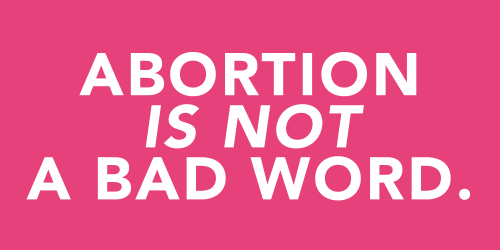
Stigma is “an attribute that is deeply discrediting,” which results in a person being “reduced in our minds from a whole and usual person to a tained, discounted one.” (This according to Erving Goffman; see the slide set referenced below from Innovating Education.)
In American society, abortion care often operates within a narrative of shame, isolation and secrecy, stigmatizing those who access abortion care as well as those who provide it. Based on epidemiological data, we know that in the United States 1 in 4 women will have an abortion by the age of 45 and that 6 in 10 of those women already have children. However, abortion stigma results in a self-perpetuating cycle: people don’t discuss their abortions to avoid being shamed and stigmatized, which makes it seem that abortion is more rare and therefore aberrant, which reinforces the stigma. Many movements in recent years have focused on reducing stigma around abortion through story telling and public discourse on abortion care.
New to the term “abortion stigma”?
Abortion Stigma: What is it and how does it affect women’s health? (Slide Set)
This slide deck provides an introduction to what abortion stigma is and how it impacts medical care. It was produced by an organization called Innovating Education at the University of California San Francisco, which produces evidence-based educational materials on abortion and contraceptive care.
For all the TedX fans:
I had an abortion, or maybe I didn’t
In this Ted Talk, Leslie Cannold discusses the cycle of shame and stigma that cloaks rhetoric around abortion.
For a reminder that the decision to have an abortion does not need an explanation:
“We don’t owe anyone an explanation”
This excerpt from Comics for Choice demonstrates that people’s dynamic life situations inform their reproductive decisions. Through one person’s story of deciding to have two abortions at different times and in two distinct life circumstances, they portray that the decision to have an abortion results from diverse life experiences. Further, this piece makes the argument that no one ever owes anyone else an explanation for their decision to have an abortion.
Reducing the Stigma Through Storytelling:
Web Video Series
In this series, people who have accessed abortion care, as well as one physician who provides abortion care, tell their stories and ponder what the United States might look like without Roe v. Wade mandating abortions be legal.
Destigmatization in the Media:
Hollywood and the Matter- of- Fact Abortion
While depictions of abortion on TV used to be scarce and highly dramatized, Hollywood is beginning to portray abortion care and the decision to have an abortion more realistically and in more diverse settings. This New York Times article provides examples of TV portrayals of abortion that both normalize abortion care and resist media’s culture of exceptionalizing reproductive healthcare.
Understanding how stigma can lead to medical consequences:
Stigma and Abortion Complications in the United States *
Lisa Harris is an Ob/Gyn whose research focuses on reproductive justice by studying the intersection of obstetrics and gynecology with social belief, policy, law, and public rhetoric. She has published a wealth of research on the impacts of abortion stigma. In this article, Dr. Harris asserts that stigma can lead to adverse medical outcomes in abortion care as she details the experiences of two patients whose need to keep their abortion care a secret directly led to medical complications.
How does abortion stigma impact abortion providers
Physicians, Abortion Provision, and the Legitimacy Paradox *
In this piece, Dr. Harris describes the impact of abortion stigma on practitioners. She outlines the challenge of the “legitimacy paradox.” While highly qualified clinicians provide abortion care, they are portrayed as deviant or illegitimate providers due to the abortion stigma. This paradox then further contributes to the secrecy surrounding abortion provision, shortages of providers, and misrepresentation of providers.
To add to your reading list:
Scarlet A: The Ethics, Law, & Politics of Ordinary Abortion
In this book, Katie Watson addresses the ethics and laws that surround abortion in the United States while also discussing the rampant stigma that surrounds this common procedure. She calls for more discussion and communication about this medical procedure that plays a role in so many people’s lives and delves into the concept of abortion as a “moral good.”
For a review of Scarlet A:
Stories from Stigma: Why Can’t We Openly Discuss Abortion?
And ‘Scarlet A’ Wants Less Shouting About Abortion and More Talking
Interested in more of Lisa Harris’s work?
- Dynamics of stigma in abortion work: findings from a pilot study of the Providers Share Workshop*
- Second Trimester Abortion Provision: Breaking the Silence and Changing Discourse*
- Abortion Politics and the Production of Knowledge*
- Abortion Providers, Stigma and Professional Quality of Life*
*Unfortunately due to copyright issues, we cannot post the full text of these papers. We have linked to the abstract and if you are a student or have access otherwise to research databases, you should be able to access the full text through those channels.
 The Abortion Library